We arrived quite early in de morning at in the station of Udaipur. In a few minutes we were surrounded by lots of tuktuk - drivers and city guides (off course). Some of them tried to show us the hotel of a friend. Since we were looking for one we picked one out and went to see it. When we arrived, the room looked nice and the tof roof restaurant wasn't bad as well so we decided to stay.
The old city of Udaipur is small. Everything is at walk distance, which makes it very nice. The narrow streets are filled with shops. The city is less dirty then others .. but maybe that's just my imagination. The city palace of Udaipur is really very beautiful. The lake palace looked very nice from distance but we couldn't visit it because it now hosts a hotel which is not very happy with non-paying tourists.
The first evening we had to stay inside the hotel because there was a Muslim festival going on and the hotel gate was closed. We had a nice view over the festival from our hotel room windows.
The second day we went to Ship Gram, this is a tourist park with different kinds of houses, found around India and it also hosts a lot of handicrafts. This park is a very small version of "Bokrijk" in Belgium. We had some delicious dinner in a restaurant close to our hotel with view over the lake.
In the evening we took the night train to Ahmedabad.
Thursday, February 07, 2008
20 - 21/1: Udaipur

Sunday, January 27, 2008
19/01: Pushkar
In the morning we checked out from the hotel in Jaipur and we went to the Holy village (it is a very small place) Pushkar.
The village is full of temples, "Holy" man, tourist shops, restaurants and cows.
First we went to the Holy lake, where the brahms ('Holy' man did a ritual with us ... seperate). After that they wanted us to tell them an amount of mony to give to "charity". I luckily gave nothing but Jan gave "just a little bit to much".
So if you ever go to Pushkar, go look at the temples and shops but please skip the Holy lake ... it is full of trash anyway!!
After this dkjfjsabfjsjkfs we still had some very nice pasta (vegetarian food because meat and also alcohol is not allowed in Pushkar) and took the taxi back to Jaipur. On the way we stopped a Marble Wholesale shop and there we could really buy very cheap nice marble!
When we were back in Jaipur we took the night train direction Udaipur to arrive there in the morning.
Tuesday, January 22, 2008
17 & 18 / 01 - Jaipur
We started off Jaipur with a city trip going over the most important / famous palaces and temples... After a quick stop at a tower that overlooks the old city, we ended up at the City Palace Complex. It contains several courtyards, some gardens and other buildings. Inside, you find several museums about clothing, armory and some artwork. Most impressive were 2 giant silver urns that were used to transport water when some Indian king went to visit King Edward in England. They are in the Guiness Book of World Records as the largest silver objects n the world. Next to the palace, you find a open air observatory (astronomy). We skipped this since it didn't look that interesting without a guide and we had to pay yet again to enter.
From here we moved on towards the Hawa Mahal or the 'Palace of Winds'. It's more like a big wall from where royal ladies could overlook the daily activities on the street. We noticed that here too, everywhere the walls are filled with scribblings by people with lack of respect. Too bad we thought once again. Our rickshaw for the day took us by Albert Hall (a large museum) that was closed for one year due to restorations. Onwards we stopped at the 'Doll Museum'. It looked very closed at first sight and we payed it a visit more out of respect for the school for deaf and mute that hosts it.
A little further we arrived at the Birla Mandir or Lakshmi Narayan Temple. This was definitely worth the visit. It's a beautiful white temple with 2 great statues in it. Since we had to leave our stuff at the gate once again, we quickly payed it a visit separately.
Our second day in Jaipur was more off a excursion day. We drove off towards the mountains and went to visit some forts in the neighbourhood. The first stop at 11km from Jaipur was the Amber fort. For the lazy ones, you can go up the steps towards this fort on a elephant. We took the foot-wagon and in about 10 minutes you are on top. It's a maze of stairs and rooms with courtyards with a great view on top. It also houses several temples.
Another rickshaw drive further up in the mountains took us to a small apartment complex. It houses 5 separate apartments and each one is nicely painted all over the place. The restaurant here is also worth a visit.
The next big fort that was awaiting us was Jaigart fort. This complex houses the biggest movable canon in the world, that was ironically only fired once to test it out.
Driving back towards the city, you can catch a glimpse of the water palace lying in the lake.
We stopped in the old part of the city for some time-filling shopping at the end of the day. Same as always... "yes friend, what you want". After a while, we ended up in a small shop in some alley of a guy that was making jewelry. After getting out of there (with a little money less and some jewelry more), we concluded our day in the pizza hut where the pizza hut boys surprised us with a little dance: Happy birthday Elise :-)
Agra: 16/01 The Big Day of Taj Mahal
The alarm clock was already ringing very early that morning. It think it was around 5 in the morning. Why? We decided to see the Taj Mahal at sunrise.
At 6 we were all ready to go and at a quarter past 6 we arrived at the Taj.
It was still dark and i think only one more person was there that time.
We picked out a nice spot to sit and wait until i was more clear. At around 6.30 it began to become clear and around 7:00 - 7:15 the sun was really coming up.
Seeing the sun coming up at the Taj Mahal was a very nice experience. It was so nice and quite (but also very cold) ... until a crowd of Indian tourists came haha.
I made some pictures to see the evolution of the Taj Mahal during sunrise and i hope to have some nice ones.
Legend relates that after the Taj was finished, the right hand of the building chief was cut off because he wanted to be sure that no copy of this wonderful building would ever be made. (still some copy's are made ... but none of them can reach the beauty of the real Taj Mahal)
After this i discovered my camera's picture settings were set to Small. I Really hope i still can make some printouts. Dad??
Aroud 8 we were back at the hotel, had some breakfast and checked out. We went to Fatephur Sikri with a hired Taxi. The guy would drive us around for the whole day for a fixed price. Tis was a really good option for us cause this way our backpacks could stay in the car.
Fathephur Sikri is a spook city. It was abandoned shortly after building time. For a long time, people thought is was because there was no more water but now some say it was for political reasons.
It contains some nice palaces and gardens.
The taxi driver took us back to Agra and there we went to see the Agra fort ... well ... the view from the lake. All entrances to forts, Palaces, ... are really expensive for Tourists and so we skipped this one. The legend relates: the emperor, who build the Taj mahal for his wife, was locked up in the Fort by his son. He wanted to build a black copy of the Taj for himself and then the city would have been broke. From his room in the fort he he could see the Taj Mahal.
After the fort we did some shopping and we took the train for a five hour trip to Jaipur.
The train trip began already with a fight about somebodies luggage and it was never really comfortable. happily, somebody from the hotel we booked in Jaipur was waiting at the station!!
Delhi - Agra: 15/01
We went to see the Red Fort. This very big fort was really worth visiting. Sadly everywhere you can see a lot of trash and discusting spitting corners (= overal is er veel afval em vuil en in veel hoeken speken de Indiers het rode goedje uit dat we kauwen)
We also went to see two temples close to the fort ... but they were closed for working.
After a nice meal we went to the busstand where we took the bus direction of Agra at 14:00.
The bus was really going very slow ... Delhi seems to have some bad traffic jams. (= file)
We only reached Agra around 19:30.
Because we didn't book a hotel we went searching for one. After seeing some cheap and bad rooms ze found one that \wasn't too bad. Service was not the best but we had a good bed!!
We went for dinner and had a very good time laughing with the boys of the restaurant.
Saturday, January 19, 2008
Merci!!!
Merci allemaal voor de verjaardagwensen en leuke berichtjes.
Ik heb een hele leuke verjaardag gehad. 3 mooie forten bezocht, beethje geshopt en nen armband gekocht en 's avonds zijn we in de pizza hut gaan eten. Daar hebben de pizza hut boys voor ons een dansje gedaan ... super grappig. Het is gefilmd door engelse jongens die ook in ons hotel in jaipur zaten en het zal wel op youtupe terecht komen :)
Die engelsen gaan trouwens naar dezelfde plaats in goa als wij ... dus die zullen we nog wel tegekomen.
Trouwens ... de berichtjes komem btw echt wel aan ... ik moet we gewoon eerst goedkeuren voor we op de blog komen .. amders krijg ik veel spamberichten ... no worries dus
voor de rest alles ok hier. seffes vertrekken ze hier van in van ons hotel in jaipur. ga proberen de blog nog wat aan te vullen de komende dagen.seffes naar Pushkar voor een bezoekje en dan deze avond de nachttrein naar Udaipur. Hopelijk valt het wat mee op de trein want van Agra naar Jaipur was het al ne fight op den trein en het was ni echt comfortabel. Gelukkig was het "maar" 5 uur haha.Alle tot een dezer!!!
groetjes,
Elise en Jan
Thursday, January 17, 2008
Delhi: 13-14 January
13/01:
We arived in Delhi around 12 o’ clock (noon).
A long row was waiting for the passport check but finally we got out. We took a prepaid taxi to the address we got from Kamal, our host in Delhi. Because of a marriage in his family his house was pretty crowded and so we stayed with a friend of Kamal: Kaushi. He is a loyer in Delhi and was very nice and friendly. Around 3 we arrived at his apartment in a richer neighborhood. We were quite tired because of the long trip but we filled our time well by going to the Lotus temple and resting a little bit. The lotus temple is made of white marble with 13 pools around it. All religions can come here to pray, meditate … as long as they do it quietly. The outside might be very nice, the inside on the other hand was not really special and quite crowded.
It was much colder then we thought it would be so we were quite cold. After putting on some more clothes, it was a little better.
In the evening our Kaushi arranged a meeting with some other Couchsurfing travelers: two French girls and a Mexican boy. They were traveling all over the world and it was nice meeting them and talking a little bit. We brought some Belgian Chocolates: the famous Guylian Sea fruit (zeevruchten) and everybody liked them very much.
At last we went to bed, tired as we were….
14/01:
We slept a little too long but I think we needed it.
We took an Auto - rickshaw to the city centre market: Connaught place. Traffic was really heavy and made us think of our stay in Mumbai.
We went to see the the Mosque but there a guy proposed to see old delhi with him as a guide. It was the the known story: you don’t have to pay me but if you are happy with my tour, you just give me something. We took our chance … Actually the tour was nice. We saw some of the houses in the maze of little streets in old Delhi. Some of them were really beautiful. He also wanted to show us some very nice (cheap?) shops were we bought some stuff. I’m sure that he got a commission on them, because he insisted on taking us there over any other place. It was a good feeling too that we were not the only ones that fell for it, we passed some other Belgians there too. They must have been as surprised as we when they heard some Flemish. Afterwards he took us to (in his words: a house bigger than the mosque) a big bazaar filled with wholesale of spices. That was rather a harsh attack on our lounges. Even the Indians around were coughing all the time. The best part must have been the top roof though. It gave a splendid view over Old Delhi. On this roof, we met the other Belgians again. So, these tours are probably pretty much the same. At this point, we had a first thought about what we would pay him. He started off the tour with pointing out we didn’t really have to pay him anything, we would soon find out that the reality was a bit different: He told us we should take care of the money matter first and added the fact he charged 650 rupees an hour. Obviously, we were disappointed to hear he charged so much. We were even more disappointed when he didn’t feel 1000 rupees were enough. So, if you ever take this kind of tour, make sure you agree on a price first, or be prepared to be heartless and don’t give in to the begging for more (We failed and gave him 300 more). After taking us back to the street, we took a regular rickshaw back to the mosque (this is a weird feeling… sitting in the back of somebody trying to move through the traffic with everybody looking at you… WHITE GUYS!). In the rickshaw, we catched up with the Belgians (yet again). So we jumped off, and joined them for just a little while more. Even though there were some people praying, you could still visit the mosque. It was pretty peaceful apart from the massive amounts of pigeons (duiven) and some children doing the take-my-picture-for-some-cash trick. Back at the main road, we found a little clothes-market. It was actually quiet, probably because it was not ran by Indians, but by Tibetans (that’s what we learned from the free Tibet posters hanging around). And they had some pretty nice stuff too. You can have a look around here without repeating “no thanks” every 20 seconds.
By now, we were starving, so we headed back to Connaught place to grab a bite. We did some window shopping here too: There are loads of western-like pricy shops here. I’m thinking adidas, nokia, levis, … After having some Chinese food, we headed to the lounge bar upstairs called Spirit. Here we met up with Kamal, who would have hosted us normally if he didn’t have family over to visit him. After another busy day, we returned to our host and hit the bed as soon as possible.
More will follow this evening. Now were going on a city tour through Jaiupur.
Byyyeee
greetings
Groetjes aan iedereen
Elise en Jan
Saturday, January 12, 2008
Departure
We are leaving!
With a swift combination of bus, train and plane, we should be in Delhi pretty soon. I should probably getting ready right now. And so I shall.
You can get a better picture of our trip if you take a look at this nice google maps thingie:
The Thingie
We'll try to make sure you hear from us again!
Jan & Elise
Thursday, January 03, 2008
Info Udaipur
Jaipur - Udaipur 405 km (night train)
Udaipur is famous around the world as a romantic city, the City Of Lakes or Venice of The East. The Pichola Lake, Fateh Sagar, Udai Sagar and Swaroop Sagar in this city are considered some of the most beautiful lakes in the state.
Places of Interest:
- City Palace: Standing on the east bank of lake Pichola, is a massive series of palaces built
 at different times from 1559 A.D. The balconies of the palace provide panoramic views of "Jag Niwas" (the world wide famous Lake palace hotel), Jag Mandir on one side and on the other the city of Udaipur. Its main entrance is through the triple-arched gate - the Tripolia, built in 1725. The way now leads to a series of courtyards, overlapping parations, terraces, corridors and gardens - a harmonic profusion hard to describe. There is a Suraj Gokhda, where the maharanas of Mewar presented themselves in the times of trouble to the people to restore confidence. The Mor-chowk (Peacock courtyard), gets its name from the vivid mosaics in glass decorating its walls. The chini chitrashala is noteworthy while a series of wall paintings of Krishna are on display in Bhim Vilas. There are numerous other palaces such as Dilkhush mahal, Sheesh mahal, Moti mahal and Krishna vilas - in memory of a princess of striking beauty who poisoned herself to avert a bloody battle for her hand by rival princess. Now the palace contains many antique articles, paintings, decorative furniture and utensils and attracts thousands of visitors every day.
 - Lake Palace - Originally known as the Jag Niwas, took t
 hree years to build and was inaugurated in 1746. Nothing but marble is used in the composition of this palace. It is now a luxury hotel.


- Fateh Sagar Lake- Lovers Paradise : Fateh Sager Lake is
 one of the most romantic vicinity for young lovers, it is situated in the north of Lake Picholas. It is the most peaceful and relaxing place to spend leisures for much of the travellers and Udaipur localities . This beautiful Fateh Sager Lake bestow with infinite beauty of the Aravali hills at the backdrop of serene lake body. It was originally build by Maharana Jai Singh in the year 1678 AD, but later on reconstructed and extended by Maharana Fateh Singh, As lot of destruction was caused, due to the heavy rains. Whereas, today Fateh Sager Lake is the most preferable site for endless wanderers, the mornings and evenings are very much refreshing around the lake, and in the middle of lake, you can see a grand Nehru park, which is a popular garden island, showcase an image of boat shaped cafe. The lake is one of the major attractions of Udaipur, these are some real moments that you will going to witness, once please your eyes with the precious sapphire of Udaipur.

Friday, December 07, 2007
Info Jaipur
Agra - Jaipur : 246 km.
Jaipur, also popularly known as the Pink City, is the capital of the Rajasthan state.
Built of pink stucco in imitation of sandstone, the city is remarkable among pre-modern Indian cities for the width and regularity of its streets which are laid out into six quarters separated by broad streets 111 ft (34 m) wide. The urban quarters are further divided by networks of gridded streets.
Therefore, Jaipur is considered by many urbanists be one of the best planned cities. Almost all Northern Indian towns of that period presented a chaotic picture of narrow twisting lanes, a confusion of run-down forts/temples/palaces temporary shacks that bore no resemblance at all to the principles set out in the Hindu architectural manuals, which calls for strict geometric planning.
Places of interest
Nahagarh Fort stands on the edge of the Arayalli Hills, overlooking the pink city.
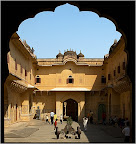 The view of the city from the fort is breath taking. Along with Amber fort and Jaigarh fort it formed a strong defense ring for the city. The word Nahargarh means the abode of tigers. Legends say that it was name after Prince Nahar whose spirit haunted the place and obstructed construction of the fort.
Built mainly in 1734 by The Maharaja Sawai Jai Singh II, it is partially in ruins. It was extended in 1868. The rooms are linked by corridors and still have some delicate frescos. There are nine apartments for the nine queens the Maharaja had and all are well planned and decorated. Nahargarh is also called as the Hunting residence of Maharajas.
- Hawa Mahal is a palace in Jaipur. Translation of this Hindi name is: Palace of winds.
 It was built in 1799 by Maharaja Sawai Pratap Singh. It forms part of the City Palace and extends the Zanana or women's chambers, the chambers of the harem (= the sphere of women in a polygynous household and their quarters enclosed and forbidden to men.) Its original intention was to allow royal ladies to observe everyday life in the street below without being seen.
 It has five stories and is constructed of red and pink sandstone, highlighted with white quakeee quick lime. The side facing the street outside the palace complex has 953 small windows, and the breeze (hawa) which circulates through these windows gives the palace its name, and keeps it cool even in hot months.
The entrance opens onto a courtyard with a double-storied building on three sides, and one on the eastern wing with three more stories, which is just one room wide. There are no stairs to reach the upper floors, only ramps.
- Amber fort is located in Amber, 11 km from Jaipur.
 The structure which is today known as Amber fort was initially a palace complex within the original fort of Amber which is today known as Jaigarh Fort. Connected with Amber through fortified passages Jaigarh fort is located on a hill above the Amber complex, and is constructed of red sandstone and white marble. It overlooks Maotha lake, and was reputed to be the treasure vault of the Kacchwaha rulers. Today, tourist can ride up to the fort from the base of the hill on an Elephant. On the ride, you can see the beautiful sights of Jaipur, a great view of Maotha lake, and the original city walls.
Once you reach the palace, you can take a tour through the fort, or view it on your own. The most magnificent sight of all is the hall of mirrors (see picture). When royalty lived there, at night when they had to come through and needed lighting they would take a single candle and because of all of the tiny intricate mirrors, the entire room would light up. - Jantar Mantar (= chanting instrument) a collection of architectural astronomical
 instruments, built by Maharaja Jai Singh II at his then new capital between 1727 and 1733. It is modelled after the one that he had built for him at the then Mughal capital of Delhi. He had constructed a total of five such labs at different locations, including the ones at Delhi and Jaipur. The Jaipur observatory is the largest of these.
The observatory consists of fourteen major geometric devices for measuring time, predicting eclipses, tracking stars in their orbits, ascertaining the declinations of planets, and determining the celestial altitudes and related ephemerides. Each is a fixed and 'focused' tool. The Samrat Jantar, the largest instrument, is 90 feet high, its shadow carefully plotted to tell the time of day. Its face is angled at 27 degrees, the latitude of Jaipur. The Hindu chhatri (small domed cupola) on top is used as a platform for announcing eclipses and the arrival of monsoons.
Built of local stone and marble, each instrument carries an astronomical scale, generally marked on the marble inner lining; bronze tablets, all extraordinarily accurate, were also employed. Thoroughly restored in 1901, the Jantar Mantar was declared a national monument in 1948.
More info on: http://www.jantarmantar.org/ and http://www.bomhard.de/englisch/jaipur/00.html.


Thursday, December 06, 2007
Hotel in Jaipur
We booked a hotel in Jaipur as my birthday present for two nights.
It looks sooo nice, don't you think?
link: http://www.umaidbhawan.com
Strange enough, this is a budget hotel and the most beautiful room costs only 60 euro.


Tuesday, December 04, 2007
Accomodation in Goa (Palolem beach)
For the first two days in Goa, we booked a bamboo hut in a small resort on Palolem beach.
The resort had some very good international reviews and it seems really nice.
Each hut has a sleeping room, bath room and a open space as you see on the pictures.
Seems nice, no?

We have a host in Ahmedabad!!
Great news: we have a host family in Ahmedabad.
Rushir Shah and his family where so nice to host us for 1 night. Thanks!
In the picture above girls from UK and Mexico where staying at their place.
It seems they have a nice accomodation for couchsurfers as there is a seperate bedroom with attached bathroom.
Check their couchsurfer profile on: http://www.couchsurfing.com/profile.html?id=2F6TTLA

Wednesday, September 26, 2007
Info: Agra

Agra is a medieval city situated on the banks of the river Yamuna, founded it in the year 1504 by a Sultan. He and his son ruled their Sultanate from Agra until 1526.
The golden age of the city began with the Mughals. It was known then as Akbarabad and remained the capital of the Mughals Empire.
Since Akbarabad was one of the most important cities in India under the Mughals, it witnessed a lot of building activity. Babar, the founder of the Mughal dynasty laid out the first formal Persian garden on the banks of river Yamuna. The garden is called the Aram Bagh or the Garden of Relaxation. His grandson Akbar raised the towering ramparts of the Great Red Fort besides making Agra a center for learning arts, commerce and religion. (Remeber that Akbar was the same guy who build Fatephur Sikri)
His son, Jahangir, had a love of gardens and flora and fauna and laid many gardens inside the Red Fort or Laal Kila.
His other son, Shah Jahan, known for his keen interest in architecture gave Akbarabad its most prized monument, the Taj Mahal, built in loving memory of his wife.
The mausoleum was completed in 1648.
Shah Jahan later shifted the capital to Delhi during his reign, but this son Aurangzeb shifted the capital back to Akbarabad and had his father imprisoned in the Fort there. Akbarabad remained capital of India during the rule of Aurangzeb until he shifted it to Aurangabad in the Deccan in 1653. After the decline of the Mughal Empire, the city came under the influence of Marathas and Jats and was called Agra, before falling into the hands of the British Raj in 1803.
Places of Interest:
- Taj Mahal: This is is one of the most famous buildings in the world. It is one of the new 7
 Wonders of the world, and one of three 'World Heritage Sites' in Agra, the others being Agra Fort and Fatehpur Sikri.
Completed in 1653 A.D., the Taj Mahal was built by the Mughal Emperor Shah Jahan as the final resting place for his favourite Queen, Mumtaz. Finished in marble, it is perhaps India's most fascinating and beautiful monument. This perfectly symmetrical monument took 22 years (1630-1652) of hard labour and 20,000 workers, masons and jewellers to build and is set amidst landscaped gardens. Built by the Persian architect, Ustad Isa, the Taj Mahal is on the bank of the Yamuna River. It can be observed like a mirage from the Agra Fort from where Emperor Shah Jahan stared at it, for the last eight years his life as a prisoner of his son Aurangzeb. It is a masterpiece of symmetry, seeming to be floating in the air from a distance, and each revealed as an illusion experienced as one enters through the main gate. -
 the impressive Agra Fort. The fort is built alongside the Yamuna river and stretches almost 2.5 km. It consists of a wall built in red sandstone and several buildings inside. The wall has 2 gates, the Delhi Gate and the Amar Singh Gate. You can only enter the fort via the Amar Singh Gate. Part of the fort is still in use by the Indian Army and are not accessible to the public, but there's still enough left to get an insight on the way the Mughals lived in the 16th century. After going through the Amar Singh Gate you walk over a ramp and enter the Great Courtyard. On the right hand sight, there's the many pillared Diwan-i-Am (Hall of Public Audience). It was built by Shah Janan in 1628. Furthermore you find the Royal Pavilions. It contains beautiful mosques. Several of the buildings are made of pure marble with beautiful carvings. To cool off the rooms in the marble pavilions, the walls were hollow and filled with running water. From the balconies in the pavilions, you have a nice view on the Yamuna river and the Taj. Legend has it that Shah Jahan desired to construct another Taj Mahal in black marble on the other side of the river Yamuna and connect the two by a bridge. This structure was intended to be his own tomb. To avoid this, his son imprisoned him in the Agra Fort where he had a view on the building erected for his deceased wife. Shah Jahan is said to have died in the Musamman Burj, a tower with a beautiful marble balcony. From there you probably have the best view on the Taj.


Tuesday, August 14, 2007
Info: Fatehpur Sikri

Fatehpur Sikri ( = city of victory close to Sikri) is a 16  century capital, build by Akbar in a rocky area, at 37 km from Agra. Because it is a ceremonial capital, the city has been never reinforced. Fatehpur Sikri is unique in its set-up and architecture.The emperor built the city for the Moslem soefi-heilige Salim Chishti. It was dedicated to Salim Chishti, because he had predicted him that he would get three sons. And indeed Akbar got three sons. Oldest prince Salim, was the later emperor Jahangir.
It took many and many years to build Fatphur Sikri but in 1585, only 15 years after the first people lived in the city, it was left empty, due to a  lack of water.
That's why this empty city is often called "Spook city".
Monday, August 13, 2007
We have a host in Delhi
Hi All,
As i already told in my first post, we will stay with some host families while travelling.
These hosts we find with the website: www.couchsurfing.com. It is really a whole community and i guess it is quite safe. When somebody has a negative experience you can also tell this on the website,...
In Delhi we will be hosted by a nice guy Kamal. He's got very good reactions and he even want to get us at the airport.
Thanks Kamal for your hospitality!! We really appreciate. (We will bring you a good bottle of wine ;-) and some belgian chocolates)
Elise
Wednesday, August 01, 2007
Info: Delhi

In this message i will tell a little bit more about our first destination in our trip: Delhi.
Delhi the second largest city of India.
Actually the city is divided in two parts. New Delhi, which is the capital of India and Old Delhi.
As the name already tell us this is the old part of Delhi and the most interesting to visit.
New Delhi is created by the English in the 20 st century.
Population : about 13 million people
Area : 1500 square kilometers
Most important places of interest:
- Chandi Chowk: This is the main street of old Delhi, crowded with colourful shops. Here india's largest wholesale market.
- The Red Fort: The emperor Shan Jahan's red sandstone fort is cons
 idered one of the most magnificent buildings in the country. It was build when Shah Jahan shifted his capital from Agra to Delhi in the 17th century. Shaped like an irregular octagon, the fort is about 2 km in circumference. Its beautiful gates are master peaces of builders art. Nowadays inside the fort are splendid ornamented buildings, pavilions, gardens, shops and museums.

- Qutb Minar: This is one of the most famous landmarks of Delhi. A tower of
 victory and a minaret once used by the muezzins build in 1193. The 72,5 meters tall tower tapers from a base diameter of 14,4 meters to a peak diameter of 2,4 meters. The tower had 5 floors, 3 build of red sandstone and two of marble and sandstone.
In 1326 the tower was damaged but luckily it was repaired. In 1368, two floors were added to the existing tower, using marble.

- Lotus temple: This spectacular building shaped like a lotus flower is
 a temple of the bahá'í. This comunity says all religions should be united. The lotus flower is build up in white marble and the building is surrounded by water. The adherents of any faith are free to visit the temple and pray or meditate silently according to their own religion. At dusk the sight of floodlit Lotus temple is simply spectacular.

- delhi haat: its a small market place in south part of delhi run by artisans from various parts of delhi (thanks Kamal for the info)
bye,
Elise
Thursday, July 12, 2007
Back to India!!
Hi All,
Because i might have some English readers, i'll post in English. Hope all of you can understand, otherwise tell me and i will try to make my posts, both in English and Dutch.
For a long time, nothing was told on this Blog, but FINALY .. i will go back to India.
My tickets are booked and on the 12th of January I will fly to Delhi.
This trip is very different from our first one. This time, we (Jan and me) will travel though a part of India, to see, smell and taste. And off course to relax a little bit. :-)
We will stay with people from couchsurfing.com (these people are willing to host travelers at their house) My Name on Couchsurfing is 'JanAndElise'.
Our Travel scheme will be something like the following:
- 12/01/08: Departure Brussels around 17:30
- 13/01/08: Arrival at Delhiaround 12:00. In Delhi we will be picked up by a nice local who is offering us a stay at his house. (Couchsufing.com)
- 14/01/08: Visiting Delhi
- 15/01/08: Tranfer from Delhi to Agra (Taj Mahal) via Fatehpur Sikri (known as the deserted city) - Sleep in Agra. Fatehpur Sikti is only 40 km from Agra
- 16/01/08: Getting up very early to see the Taj at sun rise. - Visiting Agra - Transfer to Jaipur by train in the evening - sleep in Jaipur.
- 17/01/08: Visiting Jairpur - Sleep Jaipur.
- 18/01/08: (My birthday) Transfr to, and Visiting Pushkar - sleep in Pushkar
- 19/01/08: Pushkar / Jaipur - Transfer to Udaipur (Night train)
- 20/01/08: Visit Udaipur - sleep Udaipur
- 21/01/08: Udaipur - Tranfer to Ahmedabad (Night train)
- 22/01/08: Ahmedabad - sleep Ahmedabad
- 23/01/08: Ahmedabad - Transfer to - Goa (national flight , about 2 hours) - sleep in Goa
- 24/01/08: Goa
- 25/01/08: Goa
- 26/01/08: Goa
- 27/01/08: Goa
- 28/01/08: Goa - Tranfer to Mumbai (night train) - sleep in Mumbai
- 29/01/08: Mumbai
- 30/01/08: Mumbai
- 31/01/08: Mumbai
- 01/02/08: Mumbai - At night: to Airport
- 02/02/08: 05:35: leave for Brussels.
Later on i'll write some more about the places we will visit.
byebye
Elise
Wednesday, July 20, 2005
Verandering van Url
Omdat binnekort www.eliseinindia.info zal verdwijnen zal de website bereikbaar blijven op http://nejtsille.blogspot.com
ge weet nooit da ge nog es iets wilt opnieuw bekijken :)
Vele groetjes,
Elise
Tuesday, May 24, 2005
Back in Belgium!
Jaja, we zijn terug thuis.
In de luchthaven van Zaventem werd ik opgewacht door een hele delegatie van de familie. Tante Maria, tante Christiane, de nonkel Willy's en Ninga waren van de partij en natuurlijk ook ons mama en onze papa.
Niet zo goed geslapen deze nacht. Kmoet nog een beetje aklimatiseren. :)
We zijn ongeveer 27 uur onderweg geweest van Mumbai tot Brussel.
Fotokes van de aankomst zal k nog ne keer online zetten
vele groetjes,
Elise